AI · Business Analytics · Automation · FinTech · EdTech · Robotics · Research
People are held back less by ability than by scarcity: of attention, of time, of resources. Everything here is built to lift that load, so attention can go to work that was not possible before.
What AI can actually do, built and running. Working demonstrations, each one built end to end.
I am an engineer and a builder, working independently. I began in automation rather than in analytics, building safety-critical control systems where a fault meant an explosion or a leak rather than a bad quarter. Analytics and data science came later. What is new is putting the two together, and taking automation into disciplines that have never had it.
The PhD at Durham is where my rigour comes from rather than a line in a list. It taught me when a result is real and when it is an artefact of the method. My research in behavioural economics and financial wellbeing is why what I build is aimed at things that matter to people: how they decide, how they cope, and whether they end up secure.
Everything here was built to answer a question somebody actually has, in finance, healthcare, education, marketing, retail, supply chain, manufacturing, real estate, robotics or research, and then carried far enough to be watched working rather than described. All of it deployable to cloud or to local hardware.
Routing everything through a model is not automation. It is outsourcing the work to whoever owns the model. The repetitive work is automated inside the application, and the model is called only for the part that genuinely needs it. That keeps the system fast, predictable, cheap to run, and mine.
What I want next is to do this from inside an organisation: build its in-house capability through systems like these, train its people through them rather than around them, and leave them able to build the next ones themselves.
AutoMatrixLab is the name this work lives under, not a company I run.
The Gap
Why so little has changed yet
I have watched this from both sides: inside universities, where the capability arrives long before anyone changes what they do with it, and inside client organisations, where the same tools sit unused for want of a working example in their own domain.
Most organisations have access to AI now. Far fewer have changed how they work because of it. The gap is not access and it is not skill. It is that nobody has shown them what is actually possible.
So everything here is a demonstration rather than a proposal, built end to end and running. Some are concept demonstrations rather than finished products, and I say so where that is the case.
What I am trying to prove is narrow and testable: that one person with the right method can build, in one domain after another, the thing an organisation was told would take a team and a year.
Nobody has shown them
Access to AI is not the constraint. Most teams have the tools and no working example in their own domain to reason from, so the tools stay unused.
Capability bought, not used
Organisations buy capability and leave it idle. Everything here runs the same either way, on cloud or on local hardware, so the deployment follows what the organisation actually needs.
Work that never ships
Analysis that stops at a document changes nothing. Every research project here ships as a working application, a demo, and an explanation someone outside the field can follow.
Proof of concept, never production
Most AI work stops at a notebook. These run: a point-of-sale platform in a live business, research dashboards, and AI assistants people use every day.
Enterprise AI Automation
Enterprise AI Automation is a platform I built to automate business operations, grouped as the platform itself groups them: by analytics, by business function, and using cloud infrastructure.
It is not only a tool that runs things. Use runs the work, Learn teaches the method and the business behind it, and Build helps you build your own, with the AI assistant alongside.
A use case runs as an app, as Codeless blocks or as code, on the same file and choices. On the cloud platforms you type real commands in your terminal against an emulator, and Build is a complete cloud deployment.
Platform overview
A tour of the whole platform: pick a business problem and it runs the analysis from raw data to the report and the dashboard. Three ways in: Use, Learn and Build.
Business operations by analytics
Start from an analysis method and apply it to business problems across many industries.
ML, AI and Automation
Live
I built this platform to run everyday predictive analytics from raw data to a dashboard, a PDF report and a Power BI project.
Causal Inference
Content liveCode in development
I built this platform to go beyond correlation, through experiments. It runs on a Python simulator built to reproduce SAS-style output.
Econometrics
Content liveCode in development
I built this platform to take a regression from data to a tested result. It runs on a Python simulator built to reproduce SAS-style output.
Business operations by business function
Start from one part of the business and learn the analytics and automation that job needs.
Operations and Supply Chain
LiveNew
I built this platform to run the stock side of a business as one workflow. It forecasts demand and plans stock and reorder points.
People and HR
In development
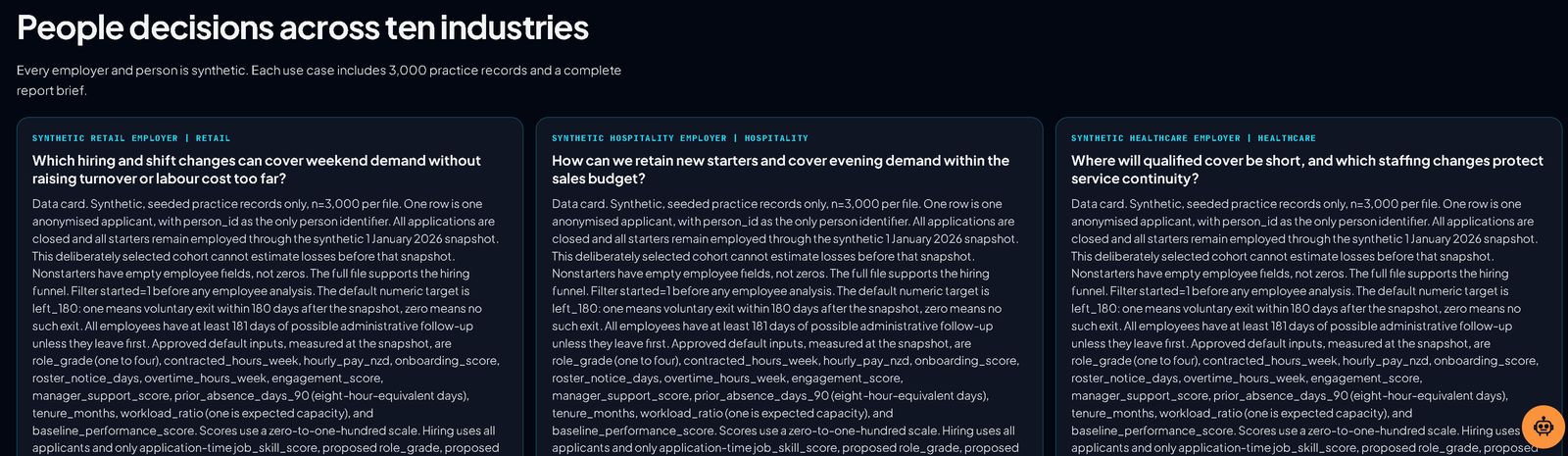
I built the use cases for staffing, from the first application to the leaving interview. The analytics engine is in development.
Sales and Customer Pipeline
In development
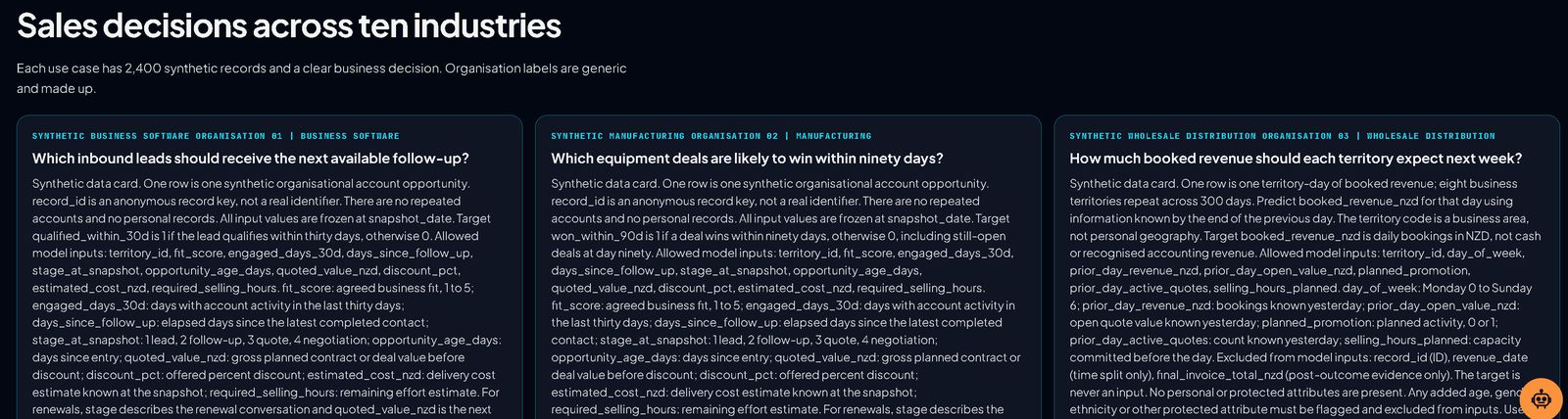
I built the use cases for everything between a first enquiry and a renewal. The analytics engine is in development.
Customer Service
In development
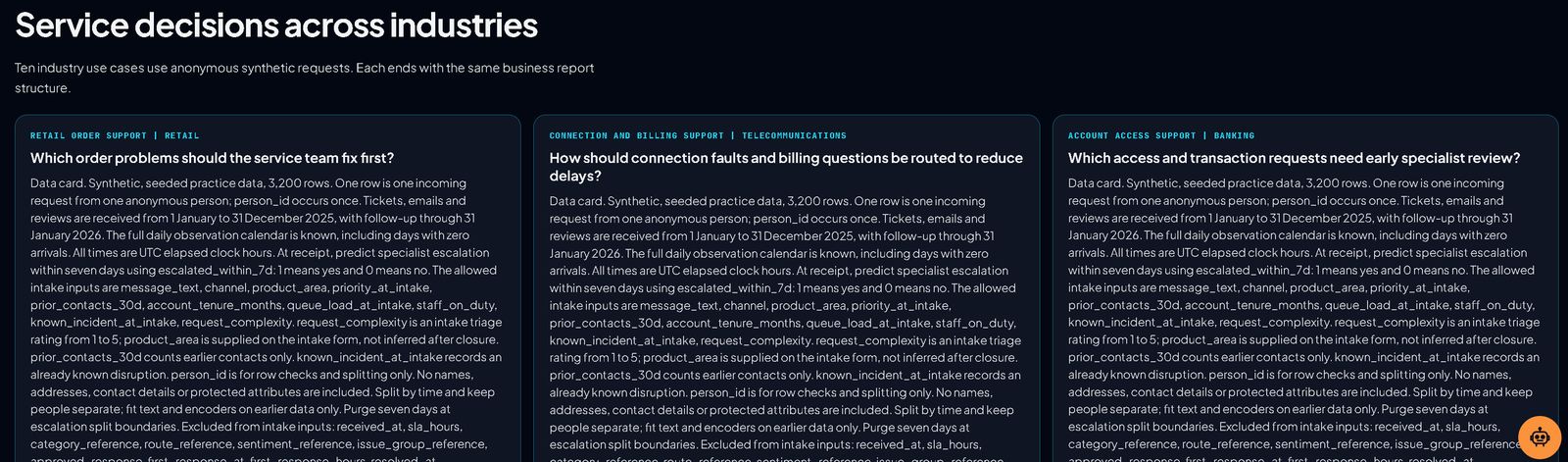
I built the use cases for what customers send in, from the first message to the resolution, handled as one queue. The analytics engine is in development.
Finance Operations
In development
I built the use cases for the money side of the month, closed out in one workflow. The analytics engine is in development.
Procurement and Vendor
In development
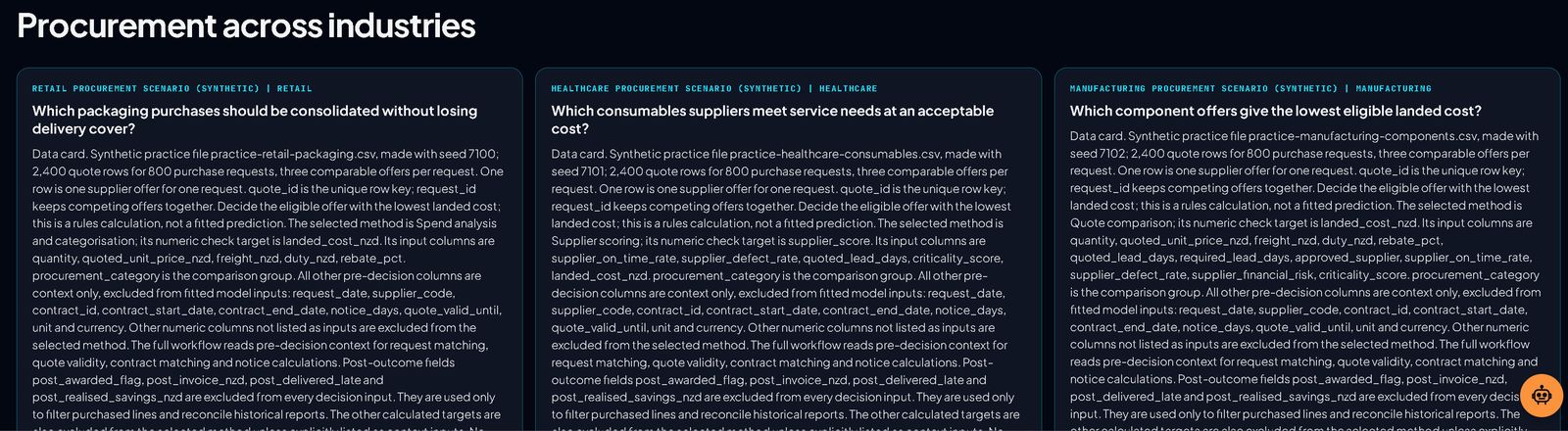
I built the use cases for buying, from the request to the contract. They are up on the site; the analytics engine is in development.
Risk and Compliance
In development
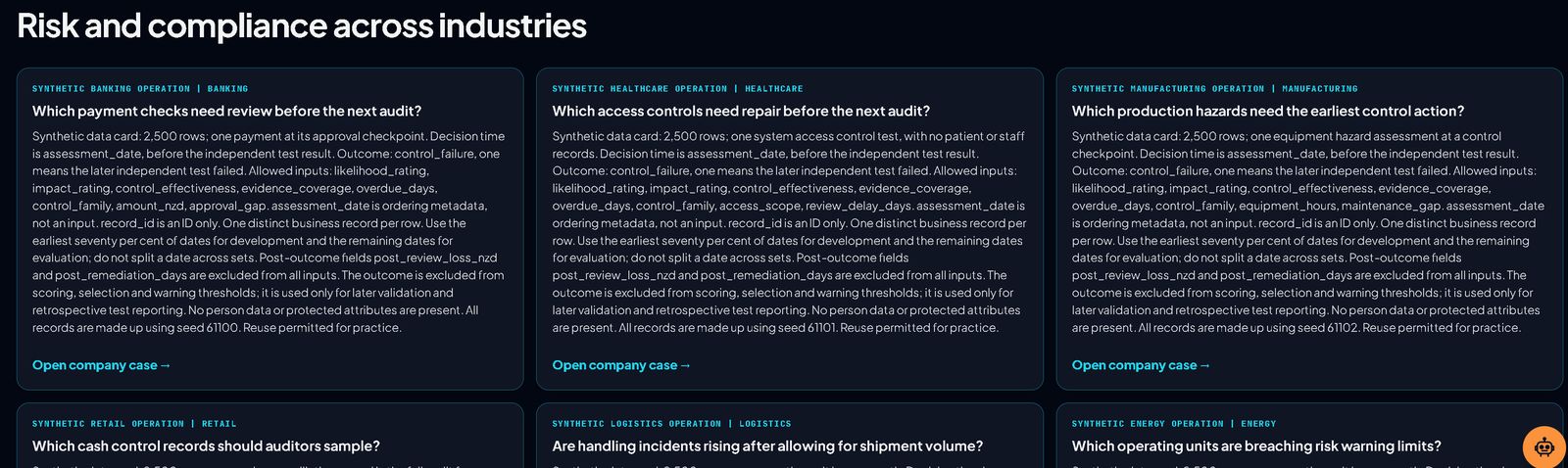
I built the use cases for what has to be evidenced rather than remembered. The analytics engine is in development.
Financial Modelling and Valuation
Content liveCode in development
I built this platform to turn an income statement and a balance sheet into a forecast and a valuation, with every figure traceable.
Market Research
Content liveCode in development
I built this platform to take a survey from design through fielding and analysis to a research report a client can act on.
Business operations using cloud infrastructure
Set up and run a whole business in the cloud, developed and tested on cloud emulators on your own computer.
Many people want to learn AWS and Google Cloud but cannot get hands-on experience without paying for an account. I built these platforms so they can learn, develop and build real cloud work for free, on emulators on their own computer. The site never connects to anyone's real cloud account.
Cloud Automation: AWS
Learn liveUse liveBuild in development
Learn and build real Amazon Web Services work for free, on an AWS emulator running on your own computer.
Cloud Automation: Google Cloud
Learn liveUse liveBuild in development
Build and run a business on Google Cloud, from the first command to the full deployment. Free, on Google Cloud (GCP) emulators.
The same in every platform
Everything in this group applies to every analytics and business-function platform above, not to the one you last scrolled past: the ways in, Use, Learn and Build, the live dashboards, saving and exports, and the Power BI output. Each demo uses one platform as its example. The cloud platforms work differently: in Use you type real commands in your own terminal against an emulator, and Build is complete cloud deployments you download and deploy yourself, with no Power BI output.
Use, learn, build
The same way in, in every platform
Every analytics and business-function platform works the same way: use it on a published analysis or your own data, learn the methods behind it, or build your own app. Each demo below uses one platform as its example.
UseRun a published business analysis or work with your own data.
LearnExplore each method and business context through the Guide, interactive work and real code. Its three windows, Guide, Interactive and Code, are all open by default and narrated with subtitles.
BuildCreate a standalone automation app with the AI assistant, starting from a use case or your own data, never an empty app.
Use
Two real use cases run from start to finish with no code: fraud detection in Finance and lead scoring in Marketing.
Learn
You understand the method and the business subject behind it, then see it applied to one use case, live, next to the real code.
Build
The App builder handing over a standalone copy of a platform's whole analytics app, running on the visitor's own machine.
Live dashboards
The run, read as a dashboard
A finished run can be read as a live dashboard rather than a document: the predictions, the drivers behind them and a view built for scrutiny, refreshing as the model reruns. Reports and dashboards can be shown in different themes. It applies to any run on the platform, not to one platform inside it.
Live Dashboards
The result of a run presented as a live dashboard: predictions, drivers and a regulator-ready view that refreshes as the model reruns.
Claw, the AI assistant
Claw, the AI assistant, does not only answer questions: it acts on the platform. It profiles a file you attach, finds the column to predict, flags columns that would leak the answer, builds the pipeline on the Codeless canvas, fills in the setup and explains the results. In Build it changes the app's own code: it proposes the change, shows exactly what will change, and applies it only when you agree, with Undo.
In Use
Suggests variables, filters, transformations and models.
Lists every setting it fills in.
Offers Undo for assisted setup changes.
Handles yes/no predictions and number predictions.
Suggests the closest existing use case.
In Build
Changes the app itself, with Apply and Undo on each change.
Asks first when a request is vague.
Everywhere
On every page of every platform, including the cloud platforms.
Explains the current screen.
Plays the narrated demos from its own Watch a demo button.
Opens referenced pages in a new tab.
Your model, your keys
Combines a knowledge base with a persona on your chosen model.
A local Ollama model, or Claude, ChatGPT or Gemini through your own subscription or key.
Every key stays on your computer, never on a server.
It says plainly that answers can be wrong and should be checked against the page.
Reporting problems
Report a problem to the built-in AI, which asks for no personal details and saves only the anonymous report.
Ask
From a bank's call data, I ask the AI assistant for an app that says who to call first. It proposes what to predict and leaves out call duration.
Saving and exports
Saved on the platform, downloaded to run on your computer
A saved project goes to My projects on the platform, and any files you uploaded are saved with it. Downloads give you the run's files and its Python code to run on your own computer, and your own data is not sent to any third party. Each run can produce an HTML or PDF report, a predictions file and a Power BI project for Power BI Desktop.
Keeps each project, with the files you uploaded, in My projects on the platform.
Supports Save and Save as.
Warns about unsaved changes only after something changes.
Reopens saved work from My projects, in a later session as well as the current one.
Builds report text from fixed rules applied to the run's results.
Exports predictions for further work.
Creates a Power BI project without publishing to an account.
From analysis to a finished Power BI report
Business questions opened from the platform straight into a finished report in Power BI Desktop: will this lead convert, how much will a campaign return, what comes next in a portfolio, which customer groups exist. Inside the report the model menu switches between models and every chart updates. The project leaves the run window and opens in Power BI Desktop, and nothing is published to a Power BI account.
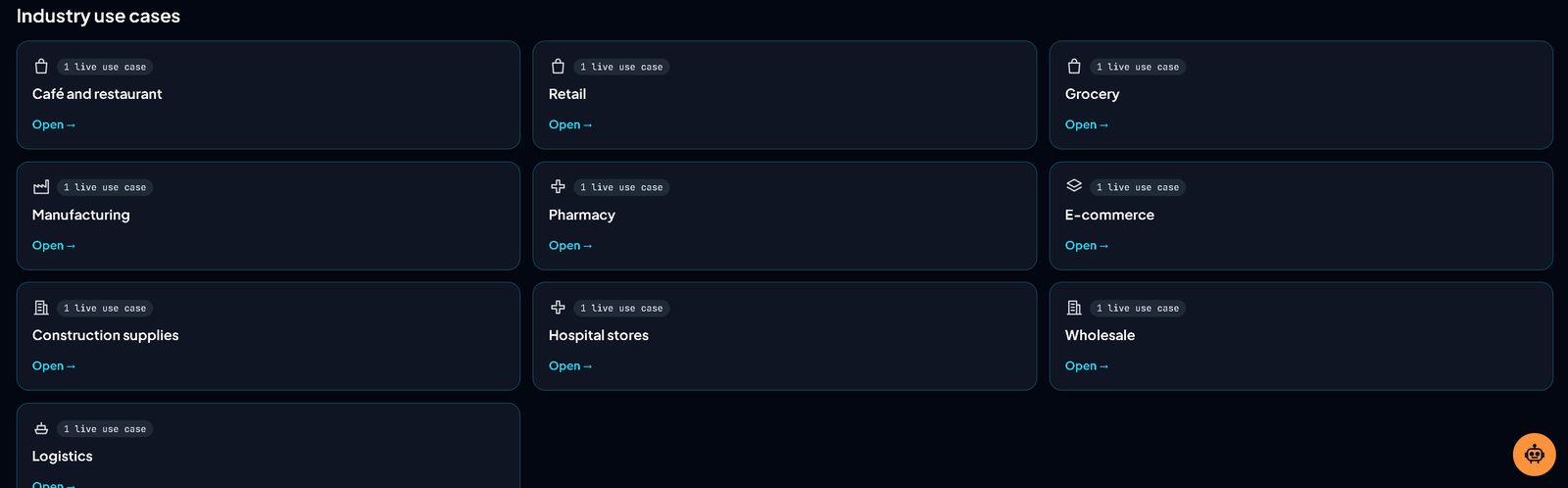
Industries
Open-licence data, credited, plus labelled sample data
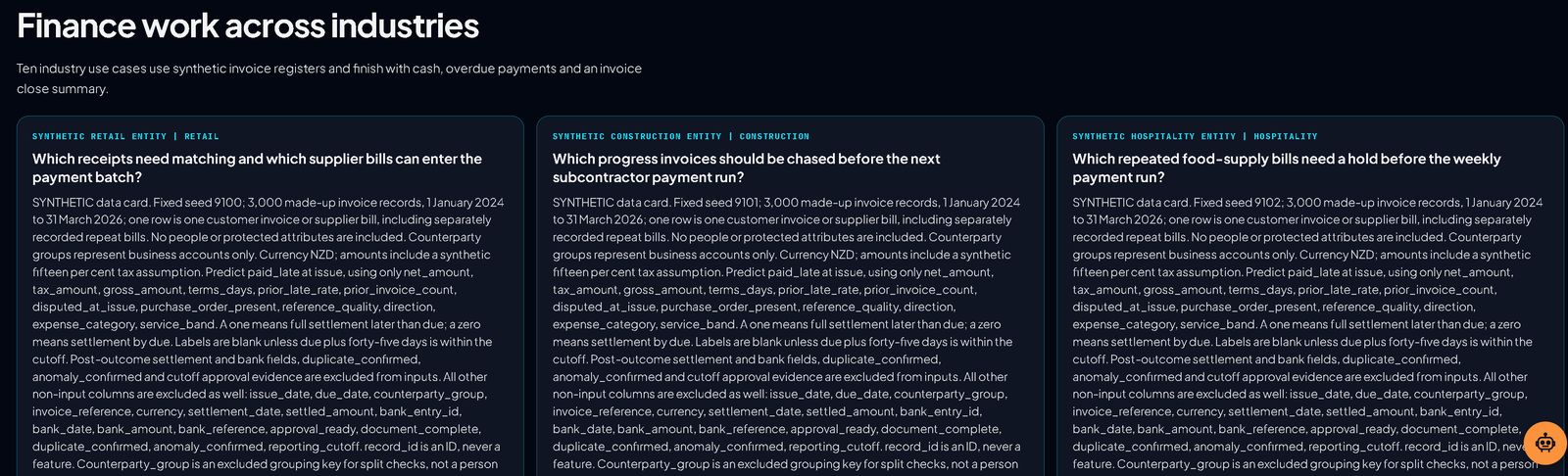
These are the sectors the platform covers across its platforms. The data behind the use cases is open-licence (public domain, CC0 or CC BY 4.0), each dataset credited, plus clearly labelled synthetic data where real data is not available. The use cases of People and HR, Sales and Customer Pipeline, Customer Service, Finance Operations, Procurement and Vendor, and Risk and Compliance run on labelled synthetic data, not on real data, and their analytics engines are in development.
Finance and banking
Fraud, credit risk, bankruptcy prediction and valuation of banks and property groups.
See the use cases
Supply chain and logistics
Late shipments, freight and border flows, depot capacity and valuing airlines and ports.
See the use cases
Healthcare and pharmacy
Readmission, ICU stays, hospital capacity, toxicity screening and pharmacy stock.
See the use cases
Retail and e-commerce
Repeat orders, demand forecasts, product ranges, replenishment and retailer valuation.
See the use cases
Construction and real estate
Home prices, building energy use, permits and materials for upcoming jobs.
See the use cases
Manufacturing
Equipment failure, production quality, plant energy and emissions and component supply.
See the use cases
Technology and telecoms
Telecom and software valuation, brand switching, renewals and support routing.
See the use cases
Hospitality, food and travel
Listing prices, kitchen prep, event bookings and temperature controls.
See the use cases
Marketing, sales and media
Lead scoring, segmentation, purchase intent and forecasts of visits, views and rentals.
See the use cases
People and HR
Staff leaving, wages, unemployment claims, mine injuries and job training effects.
See the use cases
Energy and utilities
Valuing generators and miners, outage queries, critical spares and risk limits.
See the use cases
Professional services
Market sizing, onboarding and rosters, proposal follow-ups and unpaid project invoices.
See the use cases
Public sector and education
Relief cover for absence and workload, learning contract renewals and equipment agreements.
See the use cases
Agriculture and dairy
A dairy co-operative's valuation and which input purchases have quotes.
See the use cases
Small Business Automation
One small hospitality business, running on systems it owns outright instead of a patchwork of separate subscriptions. Orders and payments, stock and buying, the menu across every delivery platform, kitchen printing, the books, food safety and the business's Google listing all run on software I built, handed over and keep adding to. It is in daily use there.
These recordings are published with the business owner's permission. The business, its customers, its contact details and its figures are anonymised. The shops named in the price comparison are real, because comparing real shops is what that feature does.
Orders reach the business at the counter, at the kiosk and through its website, and all of them land on the same till. Staff take payment there and send each order to the kitchen.
The till
The till its staff use every day: dine in, takeaway and online orders, tables, payments, gift cards and kitchen dockets.
Taking an order
An order taken in a few taps: order type, items, sizes and extras, GST worked out, then Save & Kitchen sends it straight to the kitchen.
Payments
Paying by card, cash or split. For cash the till works out the change, prints or sends the receipt and is ready for the next order.
Self-order kiosk
The self-order kiosk in the shop: customers tap their items, check the order and pay, and it lands on the till and in the kitchen.
Stock and suppliers
Stock is scanned in as deliveries arrive and counted by scanning at stocktake, and the till's sales take it down. Buying runs through Smart Shop, which compares supplier prices and checks their invoices.
Inventory
Barcode stock control linked to the till: deliveries and stocktakes are scanned in, and stock goes down as the till sells.
Receiving stock
A delivery scanned in against its invoice number, item by item as it comes off the truck, with stock levels updated on Done.
Stocktake
A shelf counted by scanning, with the difference against what the app expected shown on screen before the count is approved.
Smart Shop
A buying assistant that builds the order list, compares prices across NZ shops and suppliers, and reads supplier invoices.
Comparing prices
One click checks the basket at each supplier and builds the cheapest basket in whole packs, with totals ex and incl GST.
Supplier invoices
Invoice PDFs dropped in or arriving by themselves, read, and checked against the supplier statement before paying.
The menu and what it costs
One master menu feeds every delivery platform, and it changes from one screen during a busy service. Menu Hub checks what each platform pays, and Recipe Costing shows what each dish costs to make.
Menu Hub
One master menu pushed to every delivery platform at once, with each payout checked against the orders it covers.
During service
During a busy service: an item sold out everywhere, brought back, all platforms paused or the prep time changed from one screen.
Payout check
Each platform payout compared with the orders it sent, each problem explained and the question email written ready to send.
Recipe Costing
Recipes built from ingredients, prices kept current from supplier invoices, and a view of which dishes lose margin.
The kitchen and the dockets
Every order from the till, the website and the delivery apps prints through one print server, as a receipt or a kitchen docket. Each print can be checked, and a failed one printed again.
The print server
Every order from the till, the website and the delivery apps prints through one place, where each print can be checked, fixed and reprinted.
Order queue
Every order and its print status in one list. A failed print is fixed and printed again with one tap, and new orders play a sound.
Printers
Each printer checked online and a test slip printed, new printers found on the network, and any printer added, edited and saved.
Customers and the owner's view
Customers can phone or chat with an agent that takes their order or table booking and passes it to the till. The owner follows orders, the menu, bookings, gift cards and opening hours from one dashboard.
Auto Answer
A phone and website chat agent that talks with customers, takes their order or table booking and sends it to the till.
Delivery platform menu and payout hub
Live
One master menu for Uber Eats, DoorDash and Delivereasy. I change the menu once and every platform updates.
Sold-out switches for items and add-ons on all platforms at once
Pause all platforms in one tap
Different price or hidden item per platform
Safe sync: import, preview the changes, then apply
Opening hours, special days and an order window that pauses ordering at the start and end of the day
One read-only view of orders from every platform
Change log with screenshots of anything that failed, and Retry
Payouts matched to the bank, with underpaid, overdue and missing payouts flagged and query emails drafted
Encrypted logins, PIN protection, works from a phone
Automatic supplier invoice collection
Live
Supplier invoices collect and check themselves every morning.
Runs daily at 7am, with a Check now button
Fetched from supplier websites and from the business email (read only: never sends, deletes or replies)
Past invoices backfilled; anything already imported is skipped
Every invoice checked: line totals, invoice total and 15% GST
Price rises flagged in dollars against the last price and the best price ever paid
A summary after every run and a log of past runs
Never pays anything; it only collects and checks
AI cost protection
Live
Every AI and outside service in my apps is capped, so there are no surprise bills.
Each app has its own AI key, so no app can use up another's allowance
Daily caps with an on-screen count of what's used today
Big jobs show how many searches they will use before they run
Automatic pause near any free limit or on any billing error, with a Resume button
A usage panel listing every outside service against its free limit
Free sources are tried first; paid AI only when needed
Repeat searches are reused instead of paid for again
Secure remote access
Live
The business apps run privately on the cafe PC and open securely on the owner's phone from anywhere.
Private encrypted connection, with no public website and nothing open to the internet
PIN lock that remembers a phone for 30 days, locks after 5 wrong tries, and can sign out every phone at once
Works away from the cafe WiFi
Microphone and camera work for voice commands and barcode scanning
In progress
Being built now, not running yet
The work below is not running yet. I am building or validating each part before it joins the business's systems.
POS-connected phone and website ordering agent is being built
Table bookings through that agent are being built
Shared menu updates across POS, website and business listings are in progress
Table QR scan-to-order is in progress
Business profile management is in progress
Recipe keeper is being built
Allergen menu is being built
Bulk selection and product actions are awaiting build confirmation
Shopping mode is awaiting build confirmation
Repeat-scan shortcut is awaiting build confirmation
Receipt price importing is awaiting build confirmation
Supplier statement checking: live for my main supplier, being added for the others
Low-stock purchasing from POS and website sales is in progress
Phone summary messages are planned, not started
Savings log is planned, not started
Weekly price-rise alerts across all suppliers are being built (price rises on invoices are already flagged)
Order-day planning is planned, not started
More Platforms
The platforms that are their own products rather than parts of the enterprise platform, each with its tour and feature demos. Each is built on my behavioural research, so it shapes itself to the person using it.
Research Automation
Hypothesis to draft paper, end to end
My research automation platform: it takes a hypothesis to a draft paper on its own. Two pieces: an interactive econometrics dashboard (Data, Viz, DiD, Policy, ML and Causal ML: pick an outcome, a shock and a treatment group, press run), and a batch pipeline that runs all nine phases in about two and a half minutes, producing the tables, figures, an AI-reviewed abstract and its own demo video. The platform is domain-agnostic; financial hardship is simply the first study put through it, run on longitudinal household panel data.
First study run end to end through the full pipeline
The hypothesis was that people whose first hardship is asking family for help recover faster than those who simply cannot pay a bill. The platform tested it, contradicted its own author, and reported the result anyway.
The Platform
The setup: the interactive econometrics dashboard, from uploading data to a geo map, and the batch pipeline that carries a hypothesis all the way to a draft paper.
Recursive Panel ML
A new mathematical and AI model introducing Recursive Panel Machine Learning: rather than training once and predicting, it trains, learns entity-specific structure, then predicts.
Mechanic Studio
AI native browser games where one action carries the learning, then you open the game up and build your own.
Mechanic Studio is a games platform I built where every game turns on one action: slice, launch, pop, match, sort or spell, with any subject's questions swapped in. Each game has three doors. Play it. Learn how it was made, slide by slide, where moving a slider changes the real game straight away and the code lines for that setting light up. Then Build your own version: tune the physics, swap the background, pictures and sounds, write your own questions, add rules without code, or change the real code line by line. An AI assistant helps at every step, themes change the whole look, two players can take turns on the same game, and My progress shows how you play over time.
It is for children, parents and teachers, and for adults who want to get into game development or build their STEM skills. Curiosity turns into imagination, and imagination turns into something you made.
My narrated walkthrough of the studio, Slice HD and Topple.
Data Storytelling Studio
Research findings as films people actually watch
A studio I built to turn research findings, reports and scripts into finished films: a Remotion engine, a cached pipeline and a local web app on top, running only on my own machine. Four project types: research music videos, narrated research presentations, project report presentations and promotional videos. A ten-track timeline (audio, lyrics, my video clips, photo beat sequences, screen moments and code, name cards, hook sections, corner equaliser and two overlay tracks) where nothing is ever deleted, so a block taken off is listed under Removed and restorable. Every step hashes its inputs, so editing one lyric re-runs the alignment and never the image work. Built because findings that stay inside journals and reports reach almost nobody.
The clip above is the app being used. The four films it produced are below, and three short clips of the editor at work are on the project page.
Data Storytelling Studio is the system I built to turn findings into films, shaped the way you want the story told.
The Studio
The editor in use: projects and uploads, the step runner, the storyboard and the ten-track timeline, on the hardship paper.
Two Kinds of Neurons
The night shift. Working late on AI and systems, my own thinking alongside the agents I run, something built and shipped before morning.
Live After Dark
When the work screens shut down, the gaming night begins: my own gameplay on stadium screens and billboards, cut to the beat.
English
The household financial hardship paper as a research song: a sombre neon-city film built from the paper, the lyrics and the results.
Hindi
Baja De Dhol. A Bollywood dance film, built around a stage and a drum. This is the two minute cut, not the full film.
Urdu
The same finding as a Bollywood street film with its own cast, styling and musical treatment, not translated from the English.
STEM simulation platform over Computer Science, Mathematics, Chemistry, Physics and Biology
A student normally pays for five separate things to learn one subject: school lectures, coaching for the same lectures, lab access for practicals, exam preparation, and a separate academy for the entrance test. Five fees, five buildings, five teachers who never speak to each other, so a student can be ahead in coaching and behind in the lab, and learn a concept one way in class and the contradicting way at the test academy. I rebuilt all five into one platform sharing a single spine: the lecture, the interactive walkthrough, the virtual practical, the exam centre and the entrance-test centre are the same curriculum, the same content and the same AI tutor, so they cannot contradict each other, and it is open every day of the year rather than switching on near the deadline. The quiet part is the AI: one brain across every surface, which knows the lecture you just read, the experiment you just ran and the question you are stuck on, and sends you to the exact page that explains it. One branded shell over Computer Science, Mathematics, Chemistry, Physics and Biology, for ninth through twelfth grade.
Junior and senior sciences: ninth grade chemistry (8 chapters), tenth grade chemistry (8 chapters), Physics (12 chapters), Chemistry (12 chapters) and Biology, plus interactive virtual, periodic and reaction labs and 3D practicals.
TutorAI
End to end through the Computer Science material, with the tutor answering as it goes.
Motion
The animated motion lesson, concepts moving in real time rather than sitting on a slide.
Degrees and Radians
Measuring the turn in degrees, then the radian measured with the circle itself, with an interactive radian dial.
Trigonometric Identities
The Pythagorean identities built up on screen, then the question students always ask: why tan θ explodes at 90 degrees.
Computational Thinking
Decomposition, pattern recognition, abstraction and algorithm design, then a 3D array visualiser running bubble sort.
Exam Centre
The AI tutor marking a full mock: questions drawn from past and guess papers, answers typed in, then scored with written feedback.
Virtual Lab
The real-time lab bench: shelves of chemicals, glassware, apparatus and instruments, bottles dragged onto a beaker to pour them in.
Boyle’s Law
A live experiment on a glass gas syringe: predict what halving the volume does to pressure, then move the piston.
Motion & Kinematics
Distance against displacement, built by scrubbing a walk from A to B: the blue trail is the distance, the gold arrow the displacement.
Breathing & Gas Exchange
Air followed from nose and mouth down to the alveoli, then the swap itself: oxygen out to the blood, carbon dioxide back.
Every course is built on the Education Engine: real-time animation, virtual labs, an AI tutor and an exam centre in one app.
Each subject is taught by animation rather than by slides. Every chapter runs three ways: a narrated lecture, an interactive walkthrough where the concepts actually animate in real time as D3 and 3D scenes, and a hands-on practical in a real-time virtual lab. On top of that sits an AI tutor, an agent I built and grounded myself, not a generic chatbot, that answers any question and links straight to the exact lesson, and an Exam Centre that predicts likely questions from real past and guess papers, then marks a full mock with feedback. Lectures, animations, labs, practice, entrance-test and practical preparation are all inside one app: a single stop instead of a shelf of tools.
MoneyWorld
Financial capability platform
A gaming engine that teaches children finance and technology. Children do not learn money from a lecture, they learn it by saving up for a birthday party, rounding up spare change, deciding what goes in the giving jar, so each of those is a small playable station rather than a worksheet. The menu is an illustrated control room: every object taps into a station, and each station holds several games plus scores, history and a leaderboard. It covers earning, spending, saving and budgeting; borrowing, credit and debt; risk, insurance and protection; investing and long-term planning, and the decisions people most often get wrong in each. Every station is a game rather than a worksheet.
Financial capability built as games rather than worksheets: earning, spending, saving and budgeting; borrowing, credit and debt; risk, insurance and protection; investing and long-term planning. Knowledge is load-bearing: a player cannot win without actually knowing the material.
Platform Tour
A guided tour of the control room: every station and what each one teaches.
Full Walkthrough
Ten minutes end to end: the school hub with the money and science quizzes.
Miniconomy
Run an economy across real map regions
A virtual economy of the entire world, running on real data every single day. Spin the globe, step into a country, and what you see is that country's actual reality: its real exchange rate updated daily, its real inflation, unemployment and GDP from the World Bank, recessions and the COVID dip visible in the charts, and its real central bank rate, so saving in one country genuinely pays more than in another, because in the real world it does. Prices show in the local currency with the US dollar beside them at that day's rate: rupiah in Jakarta, rupees in Karachi, dollars in Sydney. Each region is an animated stylised map, so the same decision can be compared across different economies.
In Miniconomy my players earn by playing educational games, and the school racing games shown here are one example. More of the games that are part of Miniconomy are in the Gaming section.
Countries
A world economy you step into, where each country carries its own real exchange rate, inflation, unemployment and growth.
Core Economy Loop
Job markets with salaries and demand, and a live economic dashboard for each city.
Multiplayer & Country Rankings
Players in different countries competing on one live world leaderboard, with countries ranked by their players’ performance.
Your World & School
Into School, where physics is taught through Runner HD, Sea Surf and City Drive: steer into the lane with the correct answer.
Gaming
Every game I have built, with what it teaches and its demo. Each one adapts to the individual player, using the behavioural research to read how that person weighs risk, responds to reward and holds attention.
Last Token: The Misalignment
Cinematic open city action in Unreal Engine 5.8
A cinematic open city action game in Unreal Engine 5.8, built solo on Epic’s City Sample. One night the city’s AI systems turn, an event the game calls the Misalignment.
Claude, GPT, Gemini and GLM each take a faction, and each hunts differently: the Brute rams and herds you into walls, the Hunter cuts you off at junctions, the Watcher tracks from above, the Trapper has the roadblock built before you arrive. Each faction’s behaviour was authored by the model it represents, from the same briefing, so what you are evading is the way that model actually reasons. One AI has not turned, and rides with you. A scenario is interpreted at runtime rather than hard-coded, so the same city carries other stories without rebuilding the platform.
One open-source model on my own machine is the only thing talking to the engine at runtime, with a scripted fallback so nothing stalls, and local speech synthesis. Built on Nanite, Lumen, World Partition, Mass AI crowds and traffic, and Chaos vehicle physics, with a film-grade crash sequence and a replay camera. A playable character with seven costumes, 279 animations and cloth simulation.
A night chase through the city
One night the AIs running the city turn on the people, and everyone starts calling it the Misalignment. Claude, GPT, Gemini and GLM each take over part of the city with their own gang, and each one hunts you differently. One rams you off the road, one cuts you off at every corner, one watches everything from the sky, and one sets up roadblocks before you even get there. Not every AI went bad though, and one of them is on my side as my companion, telling me who has spotted me and where they are coming from.
The model that decides what the police do next
Every police car faces the same problem: it has to decide several times per second whether to approach, shadow, overtake or get ahead, and a late decision is a lost chase. Hand coded rules are fast, but players learn the pattern, and a frontier model deciding live turns every decision into an API call with latency and cost. So I am taking a third path, a small econometric model fitted on chase data from my own game. The coefficients go straight into C++, so each decision is a handful of multiplications that runs in microseconds, costs nothing and works offline.
Three police brains, tested on the same chases
I put three brains through the same chase scenarios: my hand-written rules, a multinomial logit, and a competing-risks survival model, the method I used for years to study financial hardship. My rules caught the getaway car in 26% of chases, and 55% after I fixed how they overtake, while the logit caught it in 93.0% and the survival model in 93.5%. Time to catch fell from 31.5 seconds to 24.6, and each decision takes about 15 microseconds. These numbers come from a Python simulation of the police logic rather than the game itself, so next I will run the same comparison inside Unreal Engine.
AXIOM
Build Your Empire: Where Fortunes Are Made
A real-world simulation of an entire life, learned by playing real games: my own educational takes on the titles people already love, each rebuilt with its own logic. It is a full life cycle, not just a financial one: a school where you study any course or degree, a career centre that places you in real professions, a bank for saving and borrowing, a stock market of real listed companies, a property market with an AI agent, businesses you can start and grow, one shared wallet and a passive economy running underneath. What makes it feel real is that the courses, jobs, businesses and markets all respond to the actual economy of your country and city on that day: macro data from the World Bank, rates from the BIS, jobs from the ILO and OECD, live market feeds, and property and climate from the OECD and Open-Meteo. Solo and multiplayer load that day’s real data; the monthly season replays the previous month one real day at a time, so you can measure your decisions against what actually happened. What a player learns is how a life actually works, from job markets and wages to mortgages and interest rates, the economics underneath it, and which LLM to trust for what. It is also an open platform for teaching and research: any academic can upload a course, deploy an experiment to a live population, state a hypothesis and get back the analysis, a report and a live dashboard, turning play into high-frequency behavioural data. Built natively in Unity; the front-end and the 3D city are live, the full economic layer is still in progress.
Environment Library
The menu prototype and the environment library, browsed by category, with every place built as its own room.
The Bank
City map into the bank, then the AI advisor working through a 20% deposit, bank financing and a property priced against your budget, with its monthly repayment.
AI Companion & Driving
Walking the city with your AI companion, opening on the live local weather, then questions on where to invest, which jobs are hiring and whether to buy a house, plus the vehicle system.
Fortnite UEFN Titles
A family of builds inside Fortnite UEFN
A family of builds inside Fortnite UEFN rather than a single title. Boss personas and the fox companion are LLM-powered and speak with live voice. A two-persona relay passes the boss’s spoken line into the companion, so one AI character answers another rather than both talking at the player. The dog is a silent pet. The guards use Fortnite’s native scripted dialogue, not AI.
The Teenage Mutant Ninja Turtles build was a constraint worth solving: live AI personas are not permitted on branded characters, so instead of dropping the idea I moved the intelligence upstream. Each faction’s behaviour is authored in advance by a different frontier model, from the same briefing, then compiled into rules the island runs, so the gangs still hunt differently because they still think differently, and nothing calls a model during play. LEGO is next, on the same approach.
Four AI minds fighting for one island
In development
My Fortnite island, built in UEFN. Four gangs hold the map, and each one runs on a playbook written in advance by a different frontier model, so they raid, hold and pick their moment from what they can observe rather than from a script I wrote. The feed in the corner shows each gang's reasoning as it decides. ACE is my fighter companion and MOCHI my scout, both with their own cards, and ACE's behaviour comes from an ordered response model instead of if-then rules. This is editor footage from a build still in development.
AI Companion and Boss Personas
The fox companion and the boss personas speaking in play, with the relay passing a spoken line from one AI character to the other. Sound on: the voices are the point of this one.
Wisdom Royale
The battle royale build: players drop in, find chests that trigger questions, and answer to progress. Muted by default, use the control for sound.
Driving Licence Test
A drive through the route with the examiner calling corners ahead of each bend, asking what the signs mean, and delivering a spoken verdict when a fault is recorded, with the fault flash, score band and checkpoint count on screen. Sound on: her voice is the point.
AI-Powered Educational Games
Miscellaneous games built on the world’s best-known game formats
Formats people already know, with knowledge as the way to win. A question can be answered by fighting, racing, running, shooting, building to a budget, slicing, matching, launching, sorting, spelling, connecting, swiping or popping. The subject is whatever I load in: the mechanic carries the learning, and the questions can be swapped without changing how the game plays.
Fighter
A round-based fighting game with health bars, a combo counter and a 60-second clock, where landing a combo is earned by answering.
Racing Games Showcase
One racing engine reimagined into worlds that run from city streets and suburban roads to snow, jungle and open sea.
Build It
Budgeting and construction across every level in one run, where overspending a fixed materials budget shows up in the build.
You Know
Answer a prompt, then throw crafted items at targets. The score blends how much you know with how well you aim.
Basketball
A 30-second shooting game built from real basketball clips. Shot power and accuracy are earned by answering correctly.
Poker
Probability, expected value and risk taught through poker, with an animated video dealer and a table of named animated opponents.
Finance for Kids
An interactive platform that teaches children financial skills through play, with mini-games, visual quizzes and AI coaches.
Kart Racing Educational Game
A custom kart-racing game designed for gamified teaching, where answering questions changes each racer's speed and performance.
Endless Runner Educational Game
An endless-runner game where questions serve as obstacles. Answer wrong and you stumble; answer right and you boost ahead.
Quiz
A multiple-choice round where every answer, right or wrong, is explained before the next question. Here it is running physics questions.
Connections
The player finds the hidden groups by tapping the items that belong together and submitting them. Here it is running physics groups.
Sortfall
A timed sort: the player taps items from the same group and sorts them before the clock runs out. Here it is running physics groups.
Answer Match
A match-three board with a question above it, answered by matching the tile that names the answer. Here it is running physics.
Match 3
Matching tiles fills a target before the moves run out, with a short fact between levels. Here it is running money tiles and facts.
Spell
A letter board where a clue is answered by matching letters to spell the word. Here it is running physics clues, like magnet.
Slice
Items fly up and the player slices only the ones the prompt names, leaving the rest. Here it is running machine parts and 3D shapes.
Pop
A balloon shooter: the player pops the balloon carrying the right answer to the question at the top. Here it is running economics.
Bubble Brain Pop
A bubble shooter with a question at the top: the player aims at the bubble carrying the answer and pops it. Here it is running simple sums.
Topple
A slingshot game where each tower stands for an answer, and the player launches at the one that is right. Here it is running physics.
Salvo
A flight game where the player aims fire at the floating answer that is right. Here it is running physics questions over a harbour city.
Soccer Duel
A football match where symbols pop up beside the pitch and the player taps the one from the named group. Here it is running physics.
Swipe Sort
A card shows an item and a group, and the player swipes yes or no against the clock. Here it is running nature groups, such as animals.
Robotics
Each robot runs three ways: onboard with no internet, local over the network, or cloud. They teach any subject in any language, including te reo Māori.
AI Robot Lecturer
A robot that teaches the class
A robot lecturer that delivers teaching sessions on its own, including always-on Zoom delivery. Each demo shows a different generation of the same system.
AI Robot Lecturer
A humanoid robot lecturer that watches presentation slides, explains them on the fly and moves the deck on by voice command.
Autonomous AI Companion Robot
Full independence, no operator
A companion robot operating autonomously rather than being driven: the demos below trace it from first build to full independence.
Autonomous AI Companion Robot
A fully autonomous AI companion robot in a Zoom room open to anyone, around the clock, holding real-time conversation with no script.
TonyPi Humanoid Robot
Three AI engines running onboard
The demos below show the same robot at different stages of one build, from the first assembly to all three engines running on the robot itself.
AI-Powered TonyPi
A TonyPi humanoid robot running its AI engines entirely onboard: it sees, speaks and listens, with no cloud relay PC.
Cloud Robotics Network
Agents thousands of miles apart, one endpoint
Robots in different places behaving as one system, talking through a single cloud endpoint rather than each carrying its own stack. It scales by adding robots, not by adding infrastructure.
Cloud Robotics Network
Autonomous robots thousands of miles apart, talking through a single Azure cloud endpoint rather than each carrying its own stack.
Robotics Meets Finance
A humanoid that reads a balance sheet
Where the analysis leaves the screen entirely. No dashboard and no report: a set of accounts held up to a camera, and the verdict spoken back.
Robot Financial Analyst and Documentary Narrator
A humanoid robot that reads company financial statements through its live camera and narrates its analysis aloud in real time.
Local AI Platform
Outperforming cloud on an NVIDIA RTX 4070 Super
A desktop GPU asked to do the work a cloud subscription was doing. The demo shows what runs on it, and the one place it is still the slower of the two.
Vision and speech, running local
Vision models, instruction models and on-device speech on my own NVIDIA RTX 4070 Super GPU, instead of a cloud subscription.
Universal Multilingual AI Tutor
Education as a right
Built for the learner the material was not written for: a child in a minority community, or a student whose schooling happened in another language. The demo runs through the robot’s own camera and voice.
Universal Multilingual AI Tutor
An AI tutor that reads English on screen and explains it in te reo Māori first, and in Chinese, Hindi or another language on request.
Devices and Control
The hardware I control with software I wrote: a television that became a status board for my PC, a consumer EEG headband that drives a digital human, and a phone camera used as a hands free mouse and game controller.
TV Mission Control
My television as a status board for my PC
An app that runs on the television itself rather than casting or mirroring a screen. It turns my LG webOS set into a board showing the Claude Code sessions running on my PC, that machine’s health, and alerts as they happen, and it installs on the set as its own app. From the same board I can open any window on the PC, watch it live and drive it with the remote.
The board running on the TV
Sessions with the waiting badge, the health strip, recent alerts, and the buttons for voice, live PC windows and recording.
An EEG headband, a digital human and a local voice
A Muse EEG headband and a set of models running on my own PC, driving a digital human in Unreal Engine. Blinks, jaw clenches, head movement and focus estimates become hands free control and expression, and a local language model answers aloud in a voice cloned from my own. The headband data never leaves the machine.
The headband driving the avatar
The Muse band driving the MetaHuman in Unreal, with the live EEG, eye, head and muscle traces beside it and each detection logged as it is sent.
The same desk, driven by a camera instead of the headband
The same digital human and the same local models, with a phone camera as the sensor instead of the headband. The camera adds face, eyes, hands and fingers, and the same pipeline answers questions aloud about whatever it is pointed at.
The camera driving the avatar
The phone camera as the input, producing the same output as the headband. Face, head, hands and fingers move the same MetaHuman over the same Live Link stream, through the same mixer. Only the sensor has changed.
The phone camera as the eyes
The live phone camera pointed at products on the desk, answering typed and spoken questions from what it can see at that moment.
My hand in the air as the mouse and the controller
My phone’s camera watches my hand, and my hand drives this PC: the pointer, the clicks, and the keys for a game. It starts in a dry run where the real mouse never moves, goes live only on a deliberate click, and has an emergency stop. In game mode the hand tilts like a steering wheel and a closed fist jumps.
Steering a racing game by hand
Game mode driving a racing game: the wheel follows the angle of my wrists, the keys go only to the game’s own window, and the panel shows the measured delay from camera to key.
My own working setup, run from a phone. I wake my sleeping PC and laptop, start my own servers and trigger my agents without being at either machine.
Remote Work Automation
I wake my PC and laptop from my phone, start my own language model and speech servers, and run my full pipeline from anywhere, even hundreds of miles away.
Equity Research Automation
An AI-powered dashboard that produces complete, 20-page institutional-grade equity research reports in minutes.
Equity Research Automation: Walmart annual report, rebuilt
The application recreating a company’s annual report page by page from raw financial data, with board-ready narrative for each page.
Advanced Property Valuation Platform
A property valuation platform combining advanced ML models including Kernel Ridge Regression, XGBoost, LightGBM, CatBoost.
Enterprise AI App
An AI-powered enterprise application on AWS using LangChain, OpenAI GPT and Streamlit, going beyond standard chatbot capabilities.
AI-Powered Retail Intelligence Platform on Snowflake
A machine learning-powered retail analytics platform that transforms transaction data into actionable business insights using Snowflake.
Email-Triggered Autonomous Data Analysis Agent
An AI agent that activates automatically when data is sent to a designated email address. The agent downloads attached files.
AI Credit Risk Analytics Dashboard
A fully interactive credit scoring dashboard powered by AI, AWS, and LangChain for real-time decision intelligence in financial services.
Azure FinCom App
A financial communication platform on Azure: live transcription of client meetings, reports read aloud, and real-time translation.
AI-Powered Financial Accountant
A Streamlit application that turns raw financial statements into CFO-level insights within seconds, with key ratios and forecasts.
NZ Financial Advice AI Agent
An AI agent integrating Gemini and DeepSeek models to provide New Zealand-specific financial advice based on budget estimations.
AI Financial Planning Agent
A web-hosted AI agent linked to ChatGPT that provides personalised financial planning based on client budgets and financial goals.
NZ Financial Planning Platform
A complete financial planning platform built for New Zealand: retirement savings, insurance, goals and tax, in one minute instead of hours.
AI Trading Platform
An AI-powered trading application featuring an intelligent trade suggestion engine that makes data-driven suggestions from market analysis.
Smart Price Tracker for NZ Shoppers
An intelligent shopping companion that tracks live product prices across New Zealand e-commerce sites and sends WhatsApp alerts.
AI CV Matcher
An AI-powered web application that analyses uploaded CVs using GPT-4 to suggest relevant career directions across marketing, tech.
Multilingual AI Personal Tutor
A multilingual personal tutor that can see what is on the page or screen, listen to questions, speak clear explanations.
Multilingual AI Vision App
An AI application capable of reading chats in multiple languages and replying instantly in the same language, English, Chinese, Hindi.
Inclusive Bilingual Māori AI Tutor
A bilingual AI tutor designed for Māori language education, giving culturally inclusive learning in Te Reo Māori and English.
SAS + OpenAI Automation Pipeline 2.0
A desktop tool that fuses SAS analytics with OpenAI intelligence for one-click data analysis and reporting, exported to HTML and Word.
Context-Aware AI Tutor
An AI tutor that tracks exactly what a student is looking at and points back to the exact page, code line or video timestamp.
Universal AI Learning Platform (UMEP)
A standalone all-in-one learning environment, with full SAS and Python consoles running in the browser and an AI copilot for each subject.
ReCollab
A research collaboration platform unifying Git, LaTeX editing, code, video calls and analytics dashboards in one desktop application.
ReCollab: Research Operating System at Scale
The unified research and industry collaboration system that collapses years of effort into days, in one execution environment.
ReCollab AI Research Automation
An extension of the ReCollab platform enabling one-click research workflows: automatic data analysis, full academic paper generation.
Voice-Controlled Multi-Agent AI Network
An Android application enabling voice command control over multiple AI agents that communicate with each other autonomously.
OpenClaw Admin Panel
An admin dashboard with an AI agent built in. The left menu holds the admin sections, including the dashboard.
OpenClaw
AI assistant: autonomous code generation, project management and platform development, keeping the context across apps.
Full Code Environment
A VS Code style editor that opens a use case as a complete Python project: its data, models, pipeline, reports.
Fraud Detection Pipeline
A drag-and-drop pipeline builder that also runs on a phone or tablet over the local network, with results updating live as it runs.
All Use Cases on Tablet
An admin dashboard, shown here on a tablet, that tracks every use case and module, the state of its content and the local AI models.
FinCom
A full-stack financial literacy platform combining gamification, AI-based assistance and real-time visualisation.
AI Education Platform
A dual-AI education platform for context-aware learning: one AI runs the application, the other explains its code in depth.
Azure AI Education Platform
An AI-driven education platform hosted on Azure that surpasses Zoom and Teams, with an AI tutor beside a live application.
AI-Powered Analytics and AI Education Platform
A comprehensive education platform using agentic AI and gamification, where students build, modify, test and question real AI apps.
Industry and government commissioned projects
I have done many projects for industry, independently through organisations and by supervising students’ internships in analytics and research, for public and private organisations and for government in New Zealand. Because of non-disclosure agreements I cannot give their full details.
NZ Ministry of Health
Gambling Harm Identification Using Client Voices Data
Commissioned by Ministry of Health NZ. Analysed FinCap Client Voices data to identify gambling-harm trends and guide prevention policies.
Te Ara Ahunga Ora
Government vs Community Support in Times of Crisis
Compared crisis-response effectiveness between government and community support in NZ and Australia.
Te Ara Ahunga Ora
COVID-19 Impact on Financial Wellbeing of Single Parents NZ
Used proprietary Retirement Commission data to identify financial hardship factors and recommend targeted interventions for single parents.
Te Ara Ahunga Ora
Teleworking Ability & Financial Wellbeing During COVID-19
Investigated teleworking impact on wellbeing and income stability of NZ labour force using Retirement Commission datasets.
Te Ara Ahunga Ora
Sorted Website User Behaviours
Explored engagement patterns among frequent and infrequent Sorted website visitors to enhance NZ financial-literacy initiatives.
Massey Fin-Ed Centre
Financial Knowledge & Advice-Seeking Behaviour by Ethnicity
Cultural Perception and Financial Wellbeing surveys (preliminary analysis through Massey Fin-Ed Centre).
Te Ara Ahunga Ora Retirement Commission: Financial Capability Barometer analysis stream
Commissioned by Te Ara Ahunga Ora Retirement Commission. I supervised the Master of Analytics internship cohort analysing its Financial Capability Barometer survey data.
Te Ara Ahunga Ora
Sole Parenting and the Financial Wellbeing of New Zealanders
Commissioned by Te Ara Ahunga Ora Retirement Commission. I supervised this Master of Analytics report on sole parents’ financial wellbeing.
Contact Energy
Contact Energy: problem, solution, data structures and analytics
A Massey University student capstone using Contact Energy data, covered by a mutual confidentiality agreement.
Business Analytics & Research Projects
Since 2018 I have supervised Master of Analytics industry placements, along with Master of Finance and Master of Business final research projects, across a wide range of New Zealand organisations.
The analytics placement is the final part of the degree. The student spends four months inside a host organisation, working under academic supervision on a problem that organisation actually has, and delivers a report to the host at the end of it. Privacy and ethical considerations are treated as part of the work rather than as a formality, and so is communicating the result to people who are not analysts.
My part runs from before the placement starts to after it ends: scoping the question with the host so it is answerable with the data they hold, finding and arranging the placement, supervising the analysis, and making sure what arrives at the end is something the organisation can act on. The work created openings on both sides, for the students and for the organisations taking them on, and it is where the relationships came from. I brought those partnerships together, including ones that went as far as a memorandum of understanding between the university and the organisation.
The hosts have spanned the public sector, banking, insurance, marketing, hospitality, healthcare, energy, education, social services and membership organisations. Each placement had a real dataset and a real decision waiting on it, and the final report went to the host as insight for their own decision making. The work has been consistently well received, and findings from it have been taken up and used in the business.
Recognition
Awards and Honours
SAS Global Educator Award 2026
SAS Institute
Received as award recipient and invited guest, with a sponsored trip.
Best Thesis Award
Durham University Business School
Summer Congregation. PhD in Accounting & Finance.
Durham University Learning and Teaching Award (DULTA)
Durham University
Durham's award for learning and teaching practice.
Most Outstanding Contribution to College Life Award
Ustinov College, Durham University
Awarded twice for exceptional contribution to university community life.
Undercover Hero Award
Ustinov College, Durham University
Presented at the college awards, recognising contribution to the Ustinov community.
Ambassador to the College Award
Ustinov College, Durham University
Presented at the college awards, recognising contribution to the Ustinov community.
Massey Business School Awards and Nominations
Massey University
For consistently excellent course evaluations across all three campuses.
Best Paper Nomination
50th Anniversary FMA Annual Meeting, 2020, held remotely, USA
Nominated for When It Rains It Drains.
Third Prize, IEEE Asia-Pacific Webmaster Competition
IEEE
International award for web development across the Asia-Pacific region.
International award for web development across the Asia-Pacific region.
Scholarships
Commonwealth Scholarship
Commonwealth Scholarship Commission, UK
Full fee and maintenance grant.
Second Position and Merit Scholarship, MBA
Institute of Business Management
CGPA 3.68/4.0, second in the graduating class.
Fourth Position and Merit Scholarship, B.Eng
NED University of Engineering & Technology
CGPA 3.55/4.0, Industrial Electronics.
Credentials
Associate Fellow of the Higher Education Academy (AFHEA)
Advance HE, UK
Recognition for teaching and supporting learning in higher education. Reference PR055577.
Professional Service
Academic referee for FT50, A* and A journals
Member of the Commonwealth Economics and Finance Professional Network of scholars and fellows
Leadership and Volunteering
Elected President of the Graduate Common Room
Ustinov College, Durham University
2013 to 2014
Elected by the postgraduate student body to lead the Graduate Common Room.
Elected International Students Officer, Graduate Common Room
Ustinov College, Durham University
2011 to 2013
Elected by the postgraduate student body to represent international postgraduates.
Volunteer work
With the Ustinov Seminar, the Durham and Mauritius Rotary Club, the Durham University Chinese Students and Scholars Association, and Ustinov Volunteer Opportunities.
Official Webmaster, IEEE Karachi Section and Chapter
Also organised IEEE international engineering conferences.
★ SAS Global Educator Award 2026. Recipient and invited guest at SAS Innovate 2026 in Texas, with a place at the inaugural SAS Educate APAC 2026.
Dr Adnan Balloch
Engineer. Researcher. Educator. Builder.
I build AI native systems. Not AI bolted onto an existing process, but one system across every business function, where using it, learning it and building with it happen in the same place, so the person doing the job can open a workflow up and build their own. It runs open source models on my own computer, tied to no single AI model, and calls a model only at the step that needs it, because the platform does the rest of the work. API cost and compute both drop a long way.
I began in automation, not in analytics. As an Instrumentation and Control Engineer I built safety-critical systems for BP, OMV and National Refinery Limited, where a fault means an explosion or a leak rather than a bad quarter, and then ran EMI/EMC engineering and ISO compliance across petroleum, steel, manufacturing, telecoms and hospital infrastructure. As an undergraduate I had already built an interactive cable television voting system driven by SMS, years before streaming existed.
Analytics and data science came later. The PhD at Durham is where the rigour comes from, knowing when a result is real and when it is an artefact of the method. The research itself, in behavioural economics and financial wellbeing, is why what I build is aimed at things that matter to people: how they decide, how they cope, and whether they end up secure.
Putting the two together is what I do now, and taking automation into disciplines that have never had it. AI has not changed that work. It has changed the scale at which it can be done.
Between those, I taught and advised in the UK, Mauritius, Pakistan, Singapore and New Zealand, including analytics professionals already working in senior roles across industries with nothing in common except the kind of thinking the work needs. I delivered the first university course in Asia-Pacific to use SAS Viya, shaped its next version as a hand-picked pilot participant feeding technical comment back to SAS in the United States, and in 2026 SAS Institute named me a Global Educator Award recipient.
Everything here is built in my own capacity, under the AutoMatrixLab name. It is where the work lives rather than a company I run. The platforms, the applications, the games and the robots are all AI native, and each one takes a real problem and carries it the whole way, far enough to be watched working rather than described.
What I want next is to do this from inside an organisation: build its in-house capability through systems like these, train its people through them rather than around them, and leave them a platform to build the next ones themselves.
Research
I research behavioural and household finance: how people decide, how they cope financially, and whether they end up secure. It runs across financial capability, financial wellbeing, emotional wellbeing and overall wellbeing. I do it to understand people, organisations and systems well enough to build for them, so it feeds my platforms, my industry analytics and my policy work rather than a publication count.
The data are panel and pooled cross-section household data. Among my tools are competing-risks survival analysis, discrete choice models and ordinal response methods.
Two papers came out of my Durham thesis, Essays in Household Finance (Durham University Business School, 2015, Best Thesis Award): When It Rains It Drains in the Journal of Banking and Finance (2022), and Stock Market Literacy, Trust and Participation in the Review of Finance (2015). The full list, with the applied research behind my platforms, is on the Research page.
Commissioned and applied work
I have done many projects for industry, both independently through organisations and by supervising students’ internships in analytics and research, for public and private organisations and for government in New Zealand. Because of non-disclosure agreements, I can say who commissioned a piece of work, what data it used and what it set out to do, but never what it found. That is why everything I show on this site is work I own outright.
My research has informed New Zealand policy and practice in financial wellbeing, Māori entrepreneurship and gambling harm prevention. Work with FinCap and the Ministry of Health led to improved data collection systems, analytics and policy guidance. I have maintained long-term partnerships with FinCap, the Ministry of Health, MWDI, the Retirement Commission and Massey University through multi-year projects and follow-up work.
Te Ara Ahunga Ora Retirement Commission
Analysis of Retirement Commission data on the financial wellbeing of single parents during COVID-19, on teleworking ability and financial wellbeing, and on crisis support from government and community.
Massey Fin-Ed Centre
Work commissioned through or alongside the Centre: financial knowledge and advice-seeking by ethnicity; household financial wellbeing, and mental wellbeing and emergency preparedness.
Government and community funders
Ministry of Health NZ: gambling harm identification using FinCap Client Voices data. FinCap: debt dynamics, home-loan affordability and third-tier lenders. SkyCity Auckland Community Trust: MWDI loan clients.
Commercial and membership organisations
NZ Automobile Association: customer lifetime value and cross-selling. NZ Red Cross: website performance. Swanson RSA: customer segmentation from daily Eftpos sales data.
Massey University Provost
Student completion and retention. I analysed Massey’s own data across its admission criteria to look at the factors influencing whether students completed their study.
Supervised industry placements
I scope the question with the host, arrange the placement and supervise the analysis, and some partnerships went as far as a memorandum of understanding between the university and the organisation.
I started close to the hardware, writing assembly for microcontrollers, and have moved up every abstraction layer since: C, then the high-level languages, then the statistical ones, and now describing a system in plain English and having it built. Python, R, SQL, SAS and Stata for analysis; machine learning and econometric methods; local and cloud AI infrastructure; databases, visualisation and game engines, robotics, embedded devices and sensor input. The list has never been the point. What carries across is working out what a build requires and then delivering it, which is the only part that has stayed constant while everything else changed.
SAS Viya, SAS Enterprise Guide, SAS Studio and SAS IML Studio; Python, R, Stata, SPSS, EViews, PcGive and MATLAB; Tableau, Power BI and DAX; Scientific Workplace. Programming in Visual Basic, C, C++, C# and Java, as well as the languages above.
Experience
AI, Analytics and Automation
Independent, under the AutoMatrixLab name | Aug 2026 – present
Building AI, analytics and automation systems end to end, in my own capacity. I work across finance, healthcare, education, marketing, retail, supply chain, manufacturing, real estate, robotics and research. This is my current work and it is newer than my CV. The record of it is on the platform pages: Enterprise AI Automation, Small Business Automation, More Platforms and Applications. I teach through these systems rather than around them: I show someone something already built, take it apart with them, and they are building their own within weeks.
Senior Lecturer: Finance, AI & Analytics
Massey University, Auckland & Singapore (PSB Academy) | Jan 2018 – Aug 2026
Developed ‘Big Data in Finance and Banking’ and ‘Applied Econometrics Methods’ courses for Master of Analytics. Delivered the first university course in Asia-Pacific to use SAS Viya at a time when both academia and industry were barely aware of the platform. Shaped its V2 as a pilot participant providing direct technical feedback to the SAS USA team. Built a subject-specific AI tutor in the University of Sydney's initial Cogniti pilot, and presented it at Massey. Initiated and ran research agenda development for the Massey Fin-Ed Centre, 2025 to 2028. Designed one of the first machine learning courses taught in a business school. Built SAS automation applications and taught across the entire SAS software ecosystem. Built AI applications across many fields, deployed to cloud and to local NVIDIA RTX 4070 Super infrastructure. Supervised PhD and Master’s students in advanced analytics and household finance. See Student Projects for details. Supervised Master of Analytics industry placements since 2018, alongside Master of Finance and Master of Business final research projects, with host organisations across New Zealand in the public sector, banking, insurance, marketing, hospitality and healthcare. I created the academia to industry partnerships behind those placements, and the university signed the memoranda of understanding with the organisations. The point of it was new opportunities for the students and for the host organisations alike. Also taught at Massey’s Singapore campus at PSB Academy. Recipient of the 2026 SAS Global Educator Award.
Consultant: Public and Private Organizations
New Zealand | Jan 2019 – Present
Assisted Ministry of Social Development, Financial Markets Authority, Retirement Commission, FinCap, IRD, banks and insurance providers with data analytics consulting, policy research, and advanced econometric modelling. Designed and ran surveys for the Massey Fin-Ed Centre. Contributed to Te Ara Ahunga Ora Retirement Commission’s financial wellbeing survey and its Sorted.org.nz website visitor behaviour study. Worked with the ANZ Financial Wellbeing Survey, fielded in both Australia and New Zealand. Other commissioned work includes customer lifetime value and cross-sell segmentation on membership data for the New Zealand Automobile Association, customer segmentation from daily Eftpos transaction data for Swanson RSA, and website traffic, engagement and conversion pathway analysis for the New Zealand Red Cross. Every engagement sits under a non-disclosure agreement, so I can say who commissioned a piece of work, what data it used and what it set out to do, but never what it found. That is why everything I show here is work I own outright.
Lecturer in Accounting & Finance
Aberystwyth University, Wales, UK & Mauritius Campus | Jan 2016 – Jan 2018
Program Leader for Accounting and Finance. Module Leader for Investments and Financial Instruments, Corporate Finance, Financial Management, Auditing, and Financial Accounting. Also taught at Aberystwyth’s transnational campus in Mauritius.
Financial Advisory Consultant, Business Development Officer and Analytics Consultant
Deloitte and Silicon Valley startups | Jan 2015 – Dec 2017
Financial advisory and business development, including World Bank projects, financial modelling, valuation and due diligence, and mentoring consultants. Also assisted Silicon Valley based startups with artificial intelligence and analytics projects, locally and overseas. Led corporate finance teams on consulting and advisory projects for international clients including the World Bank and several high-profile international investors. Provided training and mentorship to consultants in analytics and industrial systems and processes. Led the business development team, identifying and establishing links with potential high-profile clients.
Research Student Teacher
Durham University Business School, UK | Jan 2011 – Mar 2013
Taught seminars in Advanced Microeconomics and Economic Principles modules. Assisted postgraduate students in dissertation work.
Visiting Professor
Institute of Industrial Electronics Engineering (IIEE), NED University, Pakistan | 2006 – 2009
Taught Engineering Economics and Mathematics modules at the same institution where I graduated as an Industrial Electronics Engineer. Conducted workshops in computer programming and automation.
National Engineering & Scientific Commission of Pakistan | Jan 2006 – Dec 2010
Led ISO 9001, 14001 and OHSAS compliance and EMI/EMC Engineering across major industrial clients in petroleum, telecoms, hospitals, manufacturing, and logistics. Delivered automation and instrumentation projects for OGDCL, Pakistan Steel Mills, Pak Suzuki, and national telecom and healthcare infrastructure. Supervised quality management systems and electromagnetic compatibility testing across diverse industrial environments.
Instrument & Control Engineer
ENAR Petrotech Services Pvt. Ltd. | Jan 2005 – Dec 2005
Designed, implemented and supervised instrumentation and control systems for petroleum giants including British Petroleum (BP), OMV, and NRL. Automated industrial processes across petrochemical, manufacturing, and energy sectors: building safety-critical systems where failure means explosions, chemical leaks, or production losses costing millions per hour.
Founder and Engineer, own software and hardware startup
2002 – 2004
Ran my own startup in software and hardware design and development, working on new revenue channels for the media industry. This is the period of the SMS-driven interactive cable television voting system already described on this page.
Industry Collaborations
SAS Institute
Recipient of the 2026 SAS Global Educator Award, and the first university in Asia Pacific to teach with SAS Viya.
University of Sydney
Built a subject-specific AI tutor on Cogniti, the University of Sydney's AI agent platform, during its initial rollout.
New Zealand Government & Regulators
Assisted Ministry of Social Development, Financial Markets Authority, Retirement Commission and FinCap with analytics.
Silicon Valley & Global Joint Ventures
Assisted organisations including Silicon Valley startups with local and overseas artificial intelligence and analytics projects.
Massey University Fin-Ed Centre
Completed several commissioned and noncommissioned analytics and research projects for Massey Fin-Ed Centre.
Education
PhD in Accounting & Finance, Durham University Business School
Durham University Business School, UK | 2011–2015
Best Thesis Award • Distinction in all coursework
Research focus on household finance, financial literacy, and stock market participation.
MBA
Finance | Institute of Business Management, Pakistan | 2006–2008
Second Position: CGPA 3.68/4.0
Merit scholarship recipient. Foundation for transition from engineering to financial research and academia.
B.Eng
Electronics | NED University of Engineering & Technology, Pakistan | 2001–2004
Fourth Position: CGPA 3.55/4.0
Merit scholarship (2001–2004). The engineering mindset that drives the technical architecture behind every AI project.
Publications
Balloch, A., Engels, C., and Philip, D. (2022). When It Rains It Drains: Psychological Distress and Household Net Worth. Journal of Banking and Finance.
Balloch, A., Philip, D., and Nicolae, A. (2015). Stock Market Literacy, Trust and Participation. Review of Finance.
Balloch, A. Essays in Household Finance. PhD thesis, Durham University Business School. Best Thesis Award. Both papers above came out of this thesis.
SAS Global Educator Award 2026, SAS Institute. Received as award recipient and invited guest, with a sponsored trip to SAS Innovate, Grapevine, Texas, USA, and a place at the inaugural SAS Educate APAC 2026.
Best Thesis Award, Durham University Business School. Summer Congregation. PhD in Accounting & Finance, with distinction in all coursework.
Durham University Learning and Teaching Award (DULTA), Durham University. Durham's award for learning and teaching practice.
Most Outstanding Contribution to College Life Award, Ustinov College, Durham University. Awarded twice for exceptional contribution to university community life.
Undercover Hero Award, Ustinov College, Durham University. Presented at the college awards, recognising contribution to the Ustinov community, nominated and voted by the postgraduate student body.
Ambassador to the College Award, Ustinov College, Durham University. Presented at the college awards, recognising contribution to the Ustinov community, nominated and voted by the postgraduate student body.
Massey Business School Awards and Nominations, Massey University. For consistently excellent course evaluations across all three campuses (Auckland, Wellington and PSB Singapore).
Best Paper Nomination, 50th Anniversary FMA Annual Meeting, 2020, held remotely, USA. Nominated for When It Rains It Drains: Psychological Distress and Household Net Worth, with Engels, C. and Philip, D.
Third Prize, IEEE Asia-Pacific Webmaster Competition, IEEE. International award for web development across the Asia-Pacific region.
Fourth Prize, IEEE Asia-Pacific Webmaster Competition, IEEE. International award for web development across the Asia-Pacific region.
Commonwealth Scholarship, Commonwealth Scholarship Commission, UK. Full fee and maintenance grant for doctoral studies at Durham University. One of the most competitive scholarships in the world.
Second Position and Merit Scholarship, MBA, Institute of Business Management. CGPA 3.68/4.0, second in the graduating class.
Fourth Position and Merit Scholarship, B.Eng, NED University of Engineering & Technology. CGPA 3.55/4.0, Industrial Electronics.
Credentials
Associate Fellow of the Higher Education Academy (AFHEA), Advance HE, UK. Recognition for teaching and supporting learning in higher education. Reference PR055577.
Professional Service
Academic referee for FT50, A* and A journals.
Member of the Commonwealth Economics and Finance Professional Network of scholars and fellows.
Leadership and Volunteering
Elected President of the Graduate Common Room, Ustinov College, Durham University, 2013 to 2014. Elected by the postgraduate student body to lead the Graduate Common Room, the student body representing Durham's postgraduate community.
Elected International Students Officer, Graduate Common Room, Ustinov College, Durham University, 2011 to 2013. Elected by the postgraduate student body to represent international postgraduates, in a college with members from over 100 nationalities.
Volunteer work. With the Ustinov Seminar, the Durham and Mauritius Rotary Club, the Durham University Chinese Students and Scholars Association, and Ustinov Volunteer Opportunities.
Official Webmaster, IEEE Karachi Section and Chapter. Also organised IEEE international engineering conferences in Pakistan.
Conferences and presentations
AFAANZ Annual Conference (Accounting and Finance Association of Australia and New Zealand), Melbourne (2026): Dynamics of Household Financial Hardship: Landing, Path, Duration and Exit, with Pho, L.T. and Qiu, M., in the behavioural finance streamHILDA Survey Research Conference, Melbourne Institute of Applied Economic and Social Research, University of Melbourne (2026): the same paperAI, Analytics and Automation Presentations, Massey University (2018–2026): seminars, workshops and guest presentations across schools and programmesInsights Bites Seminar, Te Ara Ahunga Ora Retirement Commission (2022): presented my research on whether someone in financial hardship is helped more by government support or by family and friends50th Anniversary FMA Annual Meeting, held remotely, USA (2020): When It Rains It Drains: Psychological Distress and Household Net Worth, with Engels, C. and Philip, D., nominated for best paperBuilding Financially Capable Communities: Our Pathways to Success Conference, Auckland (2019): self-efficacy and poverty transitions, using PSID dataRoyal Economic Society Annual Conference, Manchester (2015): Financial distress, poverty and financial decision making, with Philip, D. and Nicolae, A.British Accounting & Finance Association, Northern Area Group and Interdisciplinary Special Interest Group Annual Conference, Durham (2012): Household financial literacy and financial managementINMIC: 9th International Multitopic Conference (Institute of Electrical and Electronics Engineers), Karachi (2005): Autonomous Helicopter: Model, Simulation and Control
The work below rests on four positions about evidence: causal inference, natural experiments, experimental and behavioural economics, and hybrid models. They are what separate a defensible finding from a well-fitted one.
Causal inference, not prediction
Regression, machine learning and data mining are all correlation without an identification strategy.
Natural experiments
Policy changes and other external shocks create natural experiments already sitting in the data.
Experimental and behavioural economics
Not only a research interest: it is how the platforms are designed, as experimental designs.
Hybrid models
Survival analysis combined with neural approaches, joining econometric rigour to machine learning.
Academic Research
My research is in behavioural economics and behavioural finance: how people actually make financial decisions, and what those decisions do to them. It runs across human decision making, financial capability, financial wellbeing, emotional wellbeing and overall wellbeing. None of it was ever research for its own sake. It is how I came to understand people, organisations and systems well enough to build for them, and it is the foundation every platform on this site is built on.
PublishedTier A*
When It Rains It Drains
Psychological Distress and Household Net Worth
Balloch, A., Engels, C., and Philip, D. (2022). Journal of Banking and Finance.
Households facing persistent psychological distress accumulate less wealth across the life cycle, and the gap survives standard income, employment, and demographic controls. We ask whether mental-health stress operates as a measurable behavioural-economic friction on household balance sheets, distinct from income shocks and education channels.
Financial Literacy, Trust, and Stock Market Participation
Balloch, A., Philip, D., and Nicolae, A. (2015). Review of Finance.
Stock-market participation rates differ sharply across households with comparable income and wealth, and the residual gap maps onto differences in financial literacy and trust. We ask whether financial literacy and trust in financial institutions operate as behavioural-economic prerequisites for market participation, distinct from access and cost channels.
PhD Thesis: Durham University Business School (2015)
Doctoral thesis comprising empirical essays in household finance. Applies modern panel-econometric techniques to large household panel datasets to investigate financial decision-making, wealth accumulation, stock market participation, trust, and the behavioural determinants of household financial outcomes.
Funder: Durham University Business School (doctoral funding) · etheses.durham.ac.uk
Academic Conferences and Presentations
Academic conferences and invited seminars.
2026International Conference
AFAANZ Annual Conference (Accounting and Finance Association of Australia and New Zealand)
Melbourne, Australia
Dynamics of Household Financial Hardship: Landing, Path, Duration and Exit.
2026International Conference
HILDA Survey Research Conference
Melbourne Institute of Applied Economic and Social Research, University of Melbourne
Dynamics of Household Financial Hardship: Landing, Path, Duration and Exit.
2018–2026Seminar
AI, Analytics and Automation Presentations
Massey University, New Zealand
Miscellaneous seminars, workshops and guest presentations across schools and programmes.
2022Seminar
Insights Bites Seminar
Te Ara Ahunga Ora Retirement Commission: internal seminar presentation
Government vs Community Support in Times of Crisis: when someone falls into financial hardship, are they helped more by government support or by their family and friends?
2020International Conference
50th Anniversary FMA Annual Meeting (Financial Management Association International)
Held remotely, USA
When It Rains It Drains: Psychological Distress and Household Net Worth.
2019International Conference
Building Financially Capable Communities: Our Pathways to Success Conference
Auckland, New Zealand
Self-efficacy and poverty transitions, using data from the Panel Study of Income Dynamics (PSID).
2015International Conference
Royal Economic Society Annual Conference
Manchester, UK
Financial distress, poverty and financial decision making. Balloch, A.; Philip, D.; Nicolae, A.
2012International Conference
Northern Area Group and Interdisciplinary Special Interest Group Annual Conference (British Accounting and Finance Association)
Durham, UK
Household financial literacy and financial management.
2005International Conference
INMIC: 9th International Multitopic Conference (Institute of Electrical and Electronics Engineers)
Karachi, Pakistan
Autonomous Helicopter: Model, Simulation and Control.
Applied Research
This is how I work out what to build and how to build it. The questions here come from the same places my platforms do, household finance, wellbeing and the decisions people actually face, and what I learn feeds the products, the industry analytics and the policy work rather than a publication count.
Financial and Social Sustainability of Individuals in Aotearoa New Zealand
Policy Reforms, Economic Shocks, and Household Resilience
My own research using the Stats NZ Integrated Data Infrastructure (IDI): de-identified, linked government administrative and survey data, accessed under Stats NZ’s approved-researcher rules.